What Are Screwless Dental Implants and Who Needs Them
Categories:
Losing a tooth is one thing. Figuring out the best way to replace it can bring a whole new set of questions. If you’re researching dental implants, you may have come across the term screwless dental implants and wondered whether they offer a more comfortable, natural-looking or hassle-free alternative to conventional implants.
It’s a reasonable question, particularly when you’re comparing treatment options in Australia and India and want to make an informed decision before committing to a procedure.
The term can be a little misleading, though. In most cases, screwless dental implants refer to cement-retained implant crowns, where the replacement tooth is secured to an abutment using dental cement rather than a visible fixing screw. The implant itself may still have a screw connecting its components.
So, are screwless implants actually better? Not necessarily. Both cement-retained and screw-retained crowns have their advantages, and the right option comes down to your implant position, bite, aesthetic requirements and long-term oral health.
Let’s look at how they differ, who may benefit from each approach and what you should consider before getting dental implants.
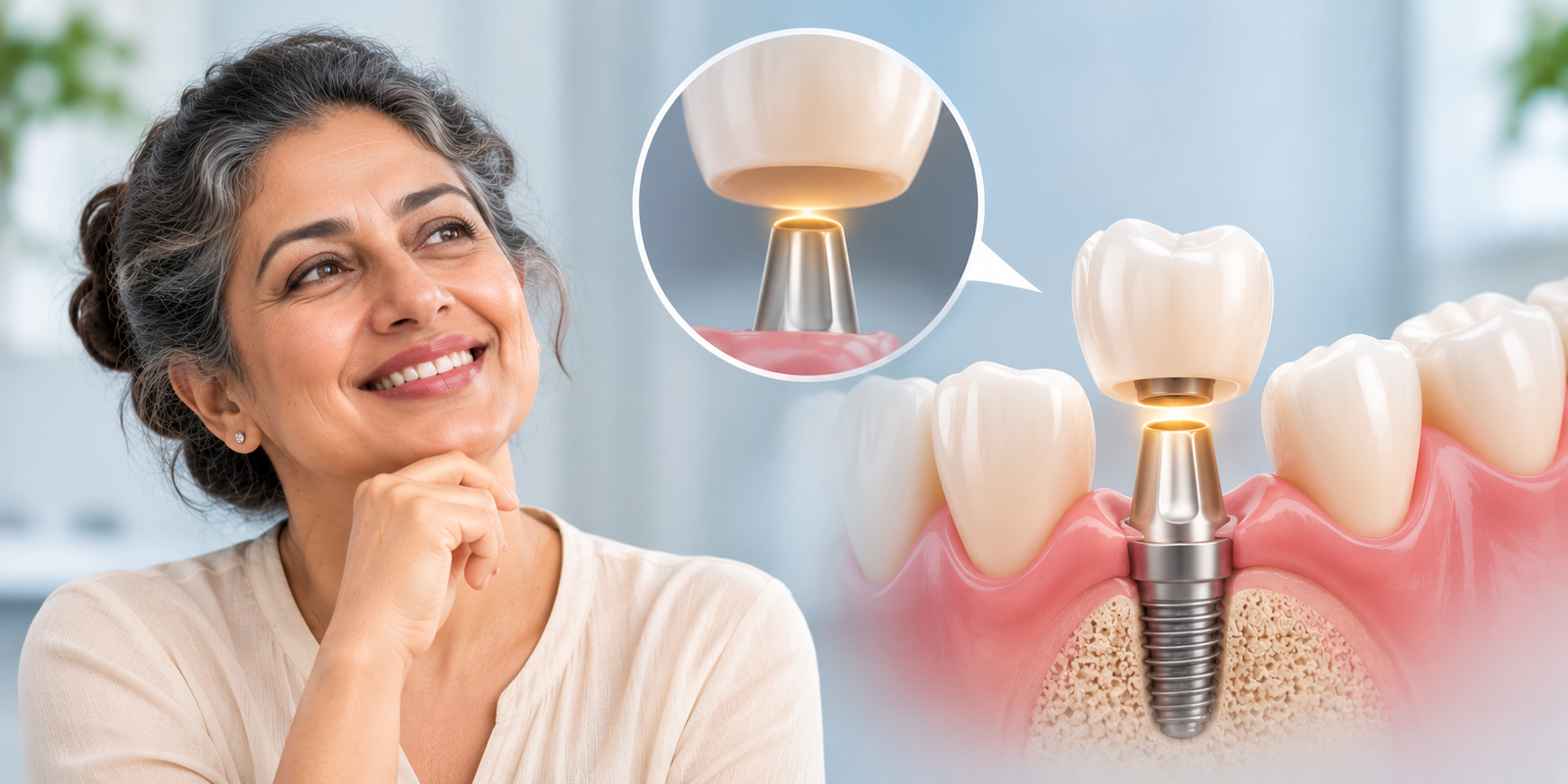
When exploring dental implant options, you may come across the term screwless dental implants, which can sound like an entirely different type of implant. However, the difference usually lies in how the replacement crown is attached rather than how the implant is placed in the jawbone. Most screwless restorations use a cement-retained design, where the artificial tooth is secured to an abutment using dental cement instead of a small fixing screw passing through the crown. To understand how this works, it helps to look at the three main components of a dental implant:
In a cement-retained restoration, the dentist first attaches the abutment to the implant fixture. The custom-made crown is then secured over the abutment using dental cement. Unlike a screw-retained crown, it does not have an access opening through which a fixing screw can be reached.
It is important to understand that no screw dental implants does not mean the entire implant system is free of screws. The abutment may still be connected to the implant fixture using a screw; the distinction is that the visible crown itself is cemented rather than screw-fixed.
Both restoration methods can provide stable, natural-looking results. The choice depends on factors such as implant positioning, available space, bite alignment, aesthetic expectations and how easily the restoration may need to be accessed for future maintenance.
Also Read – Are Dental Implants in India Safe and What to Check Before You Travel
When comparing screwless dental implants with conventional implant restorations, the real difference comes down to how the replacement crown is secured. A screw-retained implant crown is attached using a small fixing screw, while a cement-retained implant crown is bonded to an abutment using dental cement. Both methods can restore chewing function and appearance, but they differ in aesthetics, maintenance and ease of future repairs.
| Comparison Factor | Screw-Retained Crown | Cement-Remained Crown |
| Attachment method | Secured with a fixing screw | Attached using dental cement |
| Aesthetics | Small access opening, usually sealed with filling material | No screw-access opening |
| Maintenance | Easier to retrieve and access | More difficult to retrieve |
| Excess cement | No cement-related complications | Requires careful cement removal |
| Repairs | Generally simpler to access and repair | May require crown removal or replacement |
| Clinical suitability | Depends on implant position and bite | Depends on implant position and available space |
Screw-retained crowns are often preferred for full-arch treatments such as All-on-4 and All-on-6 because they are easier to remove for maintenance, repairs and adjustments. If a component becomes loose or needs servicing, the dentist can access the fixing screws without damaging the entire prosthesis. This makes them a practical option for extensive implant restorations.
A cement-retained implant crown may be suitable when implant positioning would cause a screw-access opening to appear on a visible surface, particularly when replacing front teeth. Since the crown is cemented over the abutment, it offers an uninterrupted visible surface. This can improve aesthetics, provided excess cement can be safely removed.
Ultimately, neither approach is universally better. While screw-retained crowns offer easier maintenance, cement-retained crowns can provide aesthetic advantages in selected cases. Your dentist will consider implant positioning, gum health, bite alignment and long-term maintenance before recommending the right option.
Also Read – All-on-4 Dental Implants Cost in Australia vs India
The cost of screwless dental implants can vary depending on the implant brand, crown material, abutment design and complexity of the procedure. For Australians considering dental treatment in India, comparing prices in Sydney, Melbourne and Perth with Mumbai can help understand the potential cost difference.
Cement-retained crowns do not automatically cost less than screw-retained crowns. The overall treatment estimate depends on the implant system, materials and clinical work involved.
| Treatment Location | Approximate Cost |
| Sydney, Australia | AUD$4.5k-8.2k |
| Melbourne, Australia | AUD$4.3k-7.9k |
| Perth, Australia | AUD$4.5k-7.5k |
| Mumbai (AUD equivalent) | AUD$490-1.5k |
The final screwless dental implants cost depends on several factors:
Medicare generally does not cover routine dental implant treatment in Australia. However, some private health funds offer benefits under major dental or extras cover, depending on the policy, annual limits and waiting periods.
The Australian Dental Association (ADA) fee survey can also help patients understand typical dental fees. However, individual clinics set their own prices, so it is worth requesting an itemised treatment estimate before proceeding.
For Australians considering treatment in Mumbai, compare the complete treatment quotation rather than just the advertised implant price. Include the implant fixture, abutment, crown, scans, surgery, follow-up appointments and travel expenses when calculating the overall expenditure.
Like any dental restoration, screwless dental implants come with their own set of advantages and limitations. While cement-retained crowns can offer aesthetic benefits, they also require careful planning and maintenance. Understanding both sides can help you make a more informed decision about whether this restoration approach suits your dental needs.
One of the main advantages of screwless dental implants is their aesthetic appeal. Since the crown is cemented over the abutment, there is no screw-access opening on its visible surface, allowing for a more seamless, natural-looking finish. This can be particularly beneficial when replacing front teeth or restoring areas where appearance is a priority. Cement retention also offers flexibility in certain implant positions where a conventional screw-access channel may not be ideal.
Despite these benefits, cement-retained restorations require careful handling. Excess dental cement left around the implant, particularly beneath the gumline, can irritate surrounding tissues and increase the risk of inflammation and peri-implant disease. Additionally, retrieving a cemented crown for repairs or adjustments can be more complicated and may sometimes require damaging or replacing the restoration. This makes regular dental check-ups, proper cleaning and long-term maintenance especially important.
The right dental implant restoration is not simply about choosing between screws and cement. It is about finding an approach that meets your clinical needs, looks natural and remains easy to maintain over time. While screwless dental implants can offer aesthetic advantages in selected cases, factors such as implant positioning, gum health and long-term accessibility should guide the decision.
If you’re exploring dental implant treatment in India, World Dental Specialities can help you understand your options and make informed decisions about your treatment. Whether you’re travelling from Australia, New Zealand or elsewhere, a personalised consultation can help establish the most suitable approach for your smile, with your long-term oral health at the centre of the plan.
Yes. The cement-retained crown may loosen if the dental cement deteriorates or the restoration experiences excessive biting forces. Regular dental check-ups help identify and address such issues early.
They can be. Cement-retained crowns may offer aesthetic advantages for front teeth because they eliminate the screw-access opening on the visible surface. However, implant positioning and gum health must be assessed first.
Yes, but removal is generally more complicated than with a screw-retained crown. Depending on the cement used, the dentist may need to cut through the crown, potentially requiring a replacement.
Not necessarily. However, excess cement left around the implant can irritate the surrounding gum tissue and increase the risk of peri-implant inflammation. Careful cement removal and regular professional cleaning are essential.
Yes, cement-retained crowns can replace multiple teeth in selected cases. However, screw-retained restorations are often preferred for full-arch treatments such as All-on-4 because they are easier to retrieve for maintenance and repairs.