All on 4 vs All on 6 and Which Full Arch Suits You
Categories:
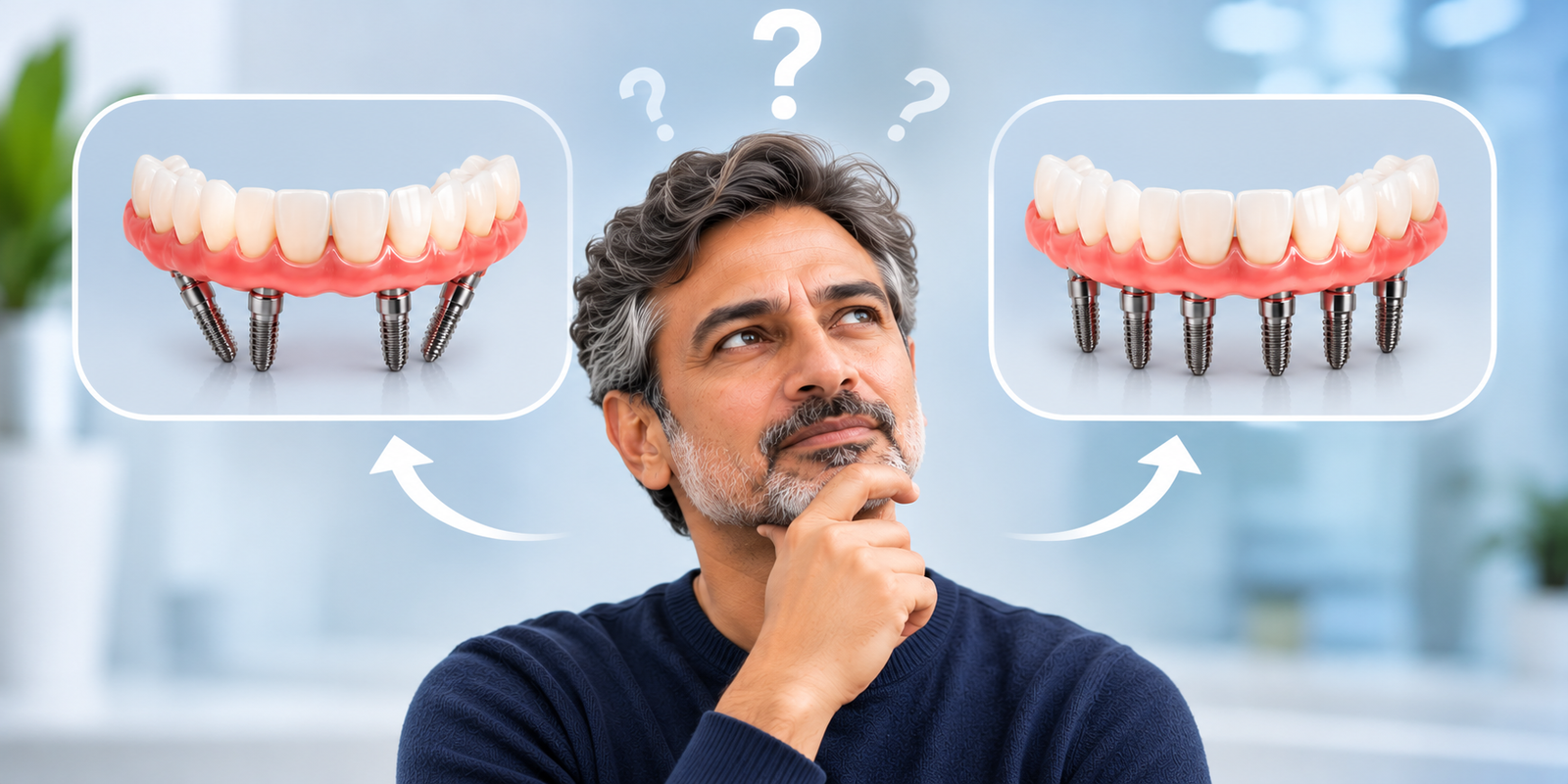
If you are missing most of your teeth or finding it increasingly difficult to manage loose dentures, you may have started exploring fixed dental solutions. Two options that often come up are All-on-4 and All-on-6 dental implants. Both can replace an entire arch of missing teeth, but they differ in the number of implants used, how the bridge is supported and what your jawbone needs to accommodate.
For Australians considering dental treatment in Mumbai, there is another question worth asking: is the additional cost of All-on-6 justified, or can All-on-4 deliver the results you need?
The answer depends on more than your budget. Your bone density, bite strength, oral health and long-term expectations all play a role. Let’s look at how these treatments compare, what they cost in Australia, New Zealand and Mumbai, and how to decide which option makes sense for you.
Both All-on-4 and All-on-6 are full-mouth rehabilitation techniques that use dental implants to support a fixed bridge of replacement teeth. Instead of placing an individual implant for every missing tooth, your dentist strategically positions four or six titanium implants in the jawbone to support an entire arch.
This approach is also part of a broader treatment category known as all-on-x dental implants, where the number of implants is determined by the patient’s clinical requirements.
All-on-4 uses four dental implants to support a complete arch of replacement teeth. Typically, two implants are placed towards the front of the jaw, while the other two are positioned at an angle towards the back.
Angled placement helps dentists make better use of the available bone and may reduce the need for bone grafting in selected patients.
For suitable candidates, a temporary fixed bridge may be attached shortly after surgery, sometimes within 24–48 hours. However, immediate loading depends on implant stability, bone quality and the overall treatment plan.
As the name suggests, all-on-6 dental implants uses six implants to support a complete arch of replacement teeth.
The additional two implants create more support points for the bridge. This can help distribute chewing forces across a wider area, particularly in patients with stronger bite forces or specific anatomical requirements.
However, six implants require suitable bone volume at the additional implant positions. Bone grafting may be recommended if sufficient bone is unavailable.
The key difference is straightforward: All-on-4 uses four implants, while All-on-6 uses six. The more important question is which configuration can safely and predictably support your new teeth.
Also Read – All on 4 Dental Implants Cost and How It Works in India
When comparing all-on-4 vs all-on-6 dental implants, it is easy to assume that more implants automatically mean a stronger or longer-lasting result. That isn’t necessarily true.
Both techniques have demonstrated good clinical outcomes when appropriately planned. The choice depends on your jawbone condition, bite, implant positioning and the design of your final bridge.
| Comparison | All-on-4 | All-on-6 |
| Number of implants | 4 per arch | 6 per arch |
| Bone requirements | Can utilise available bone through angled placement | Requires suitable bone at additional implant positions |
| Force distribution | Chewing forces supported across four implants | Additional support points for distributing forces |
| Surgical considerations | Fewer implant placements | More implant placements |
| Treatment costs | Generally lower | Generally higher |
Not automatically. The additional implants may offer advantages in selected cases, particularly where the bite places greater demands on the restoration.
However, a well-planned All-on-4 restoration can also provide excellent stability and function. The success of either procedure depends on implant positioning, primary stability, bone quality, prosthetic design and ongoing maintenance.
For example, someone with adequate bone and a straightforward bite may be perfectly suited to All-on-4. Another patient with different anatomical requirements may benefit from six implants. The aim should be to use the number of implants your jaw actually needs, rather than opting for the higher number simply because it sounds better.
Also Read – All on 6 Dental Implants Cost and Results Guide in India
Once you have decided between All-on-4 and All-on-6, there is another important decision to make: the material used for your permanent dental bridge. After all, the implants provide the foundation, but the bridge is what you will see, eat with and rely on every day. From aesthetics and durability to comfort and maintenance, the material you choose can make a difference to your long-term experience.
An all on 6 zirconia bridge is a popular choice for patients looking for a durable, fixed full-arch restoration. Zirconia is a high-strength ceramic material that can be customised to replicate the colour, shape and appearance of natural teeth. It offers good resistance to staining and wear, making it suitable for patients who want a natural-looking restoration without a visible metal structure. However, the final design and thickness need to be planned around your bite and available space.
Acrylic and composite bridges are other options used in full arch dental implants. Acrylic restorations are generally more economical and can be relatively easy to repair or modify if a tooth chips or wears down. Composite materials can also offer good aesthetics and repairability, depending on the restoration design. However, these materials may require more maintenance over time due to wear, staining or chipping. Your dentist can explain whether they are suitable for your expected chewing demands and treatment budget.
When comparing zirconia, acrylic and composite bridges, consider how each material performs beyond its initial appearance. Zirconia offers high strength and good colour stability, while acrylic and composite restorations may be easier to repair but can require more frequent maintenance. All three options need regular professional reviews and daily cleaning around the implant-supported bridge. Your oral hygiene routine, bite habits and willingness to attend follow-up appointments will influence how well your restoration performs over time.
The most expensive material is not necessarily the best choice for everyone. If you have a strong bite or grind your teeth, your dentist needs to consider the forces placed on the bridge before recommending a material. Available jaw space, opposing teeth, aesthetic expectations and your budget also matter. For instance, a patient prioritising durability and aesthetics may prefer zirconia, while someone looking for a more economical or easily repairable option may consider acrylic or composite. The right choice should balance appearance, function, comfort and long-term maintenance rather than focusing on material strength alone.
Choosing between All-on-4 and All-on-6 is not simply about whether four or six implants sound better. The right full arch dental implants solution depends on your jawbone condition, bite strength, oral health and long-term expectations. Before recommending either treatment, your dentist will assess several factors to determine how many implants can provide adequate support for your replacement teeth.
Here are five important considerations that can influence your treatment plan:
At the end of the day, the decision should be based on clinical suitability rather than implant count alone. A detailed assessment, including digital scans and bite evaluation, can help your dentist recommend whether All-on-4, All-on-6 or another all-on-x implants configuration is better suited to your dental needs.
Restoring an entire arch of teeth is a significant investment in your oral health, comfort and quality of life. While All-on-4 may be suitable for patients with specific bone and bite requirements, All-on-6 can offer additional support in cases where the clinical assessment calls for it. Neither option is universally better; the right treatment depends on your dental condition, long-term expectations and overall health.
For Australians and New Zealanders exploring full arch dental implants in India, Mumbai offers an opportunity to access treatment at a more affordable price point. However, clinical expertise, transparent pricing, quality of materials and post-treatment care should remain central to your decision.
At World Dental Specialities, patients can explore personalised full-arch treatment options based on their dental needs. Whether you are considering All-on-4, All-on-6 or another implant-supported restoration, a consultation can help you understand the available options, expected costs and treatment journey before planning your visit to Mumbai.
1. What is the main difference between All-on-4 and All-on-6 dental implants?
The main difference is the number of implants supporting the fixed bridge. All-on-4 uses four implants, while all on 6 dental implants uses six to provide additional support and distribute chewing forces.
2. Are All-on-6 dental implants better than All-on-4?
Not necessarily. All on 4 vs all on 6 depends on your jawbone density, bite strength and oral health. Both treatments can offer successful long-term results when planned appropriately.
3. How much do All-on-6 dental implants cost in Australia?
The all-on-6 dental implants cost australia patients can expect generally ranges from AUD $25,000 to $50,000+ per arch, depending on the clinic, implant system and bridge material.
4. Is an All-on-6 zirconia bridge worth the investment?
An all on 6 zirconia bridge offers strength, natural-looking aesthetics and good resistance to staining. However, its suitability depends on your bite, available space, restoration design and budget.
5. What are All-on-X dental implants, and how do they differ from All-on-4?
All-on-x dental implants refer to full-arch restorations supported by a planned number of implants. All-on-4 is one approach, while All-on-6 uses six implants. The configuration depends on individual clinical requirements.